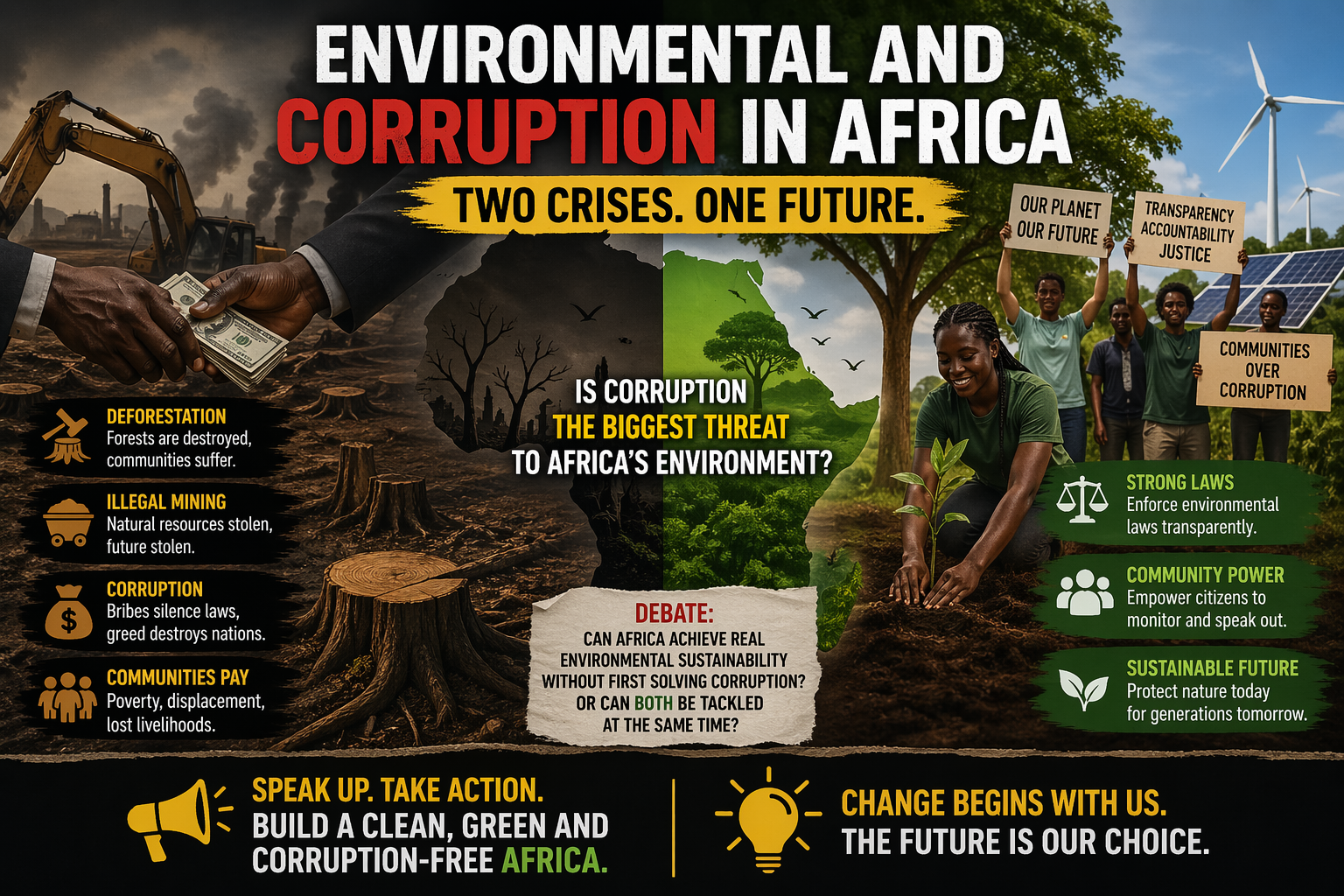
Is Corruption the Biggest Threat to Africa’s Environment?

Africa is rich in natural resources, yet environmental destruction continues at an alarming rate. From illegal logging and mining to land grabbing and pollution, the question is no longer just about weak environmental systems—but about corruption enabling these practices.

Are environmental laws failing, or are they simply not enforced because of vested interests? In many cases, those responsible for protecting natural resources are the same actors benefiting from their exploitation.

This raises a difficult question:

Is corruption the root cause of Africa’s environmental crisis—or are poverty and survival pressures equally to blame?

If corruption is driving environmental degradation, then are climate solutions alone enough? Or must governance reform come first?

Debate:

Can Africa achieve real environmental sustainability without first solving corruption? Or can both be tackled at the same time?


Files

Comments (16)

Team leader Green Her Climate Response Uganda
edith ajambo

The victims are often the least powerful—and the least responsible:

Rural communities who lose forests, water sources, and livelihoods
Urban populations facing floods, heat, and pollution due to poor planning
Future generations who inherit depleted ecosystems
Wildlife and biodiversity, which have no voice in these systems

Fonyuy Bintar

Framing corruption as the biggest threat oversimplifies the problem. It’s a major driver, no doubt - but it operates within a wider system of weak governance, economic pressure, and social realities.

In many contexts, including Cameroon, environmental laws are not absent - they’re unevenly enforced. Corruption enables illegal logging, mining, and land use, but it also thrives where livelihoods are fragile and institutions are stretched. So it’s not just corruption vs poverty - they reinforce each other.

That said, climate or environmental solutions that ignore governance will underperform. You can fund restoration or conservation, but if accountability is weak, leakages will persist.

The real question is sequencing vs integration - and the answer is clear: both must be tackled together. Strengthening transparency, local accountability, and community ownership can reduce corruption risks while delivering environmental outcomes.

Sustainability won’t come from technical solutions alone - it will come from aligning governance, incentives, and local realities.

Hi! It's Frances at youth a COP 30 meeting.
Frances Karploh Tarpeh

Climate and environmental change/justice is a human rights issue because the least polluters are the mostly affected ones from the climate or environmental crisis and are deprived of access to the basic necessities, resources and structures to mitigate and stay resilience unlike the main perpetrators or big polluters. And this is fueled by greed giving birth to corruption that in turns birth inequality, inequity, inaccessibility and injustices in every fabric of our societies. Especially Africa.

Because of poverty and greed, the pure water hawker selling in the streets are as corrupt as the Corporate CEO or Oil Mogul.

Hence, we cannot achieve real environmental sustainability if we do tackle corruption as we go along

Dramane Ouattara

La prise de conscience par les décideurs influence énormément l'économie africaine face au dilapidement des fonds au lieu d'attendre des résultats, on assiste à des activités inachevée ou abandonner.
Les victimes sont les populations défavorisés et vulnérable.

Esther Mutugi

In matters corruption and Environment, can anyone relate on how African countries get funding for climate change yet youth organizations still lack funds to execute climate action ideas and projects.

‎I am a Timbuktu-based entrepreneur with a Bachelor’s in English and an Alumnus of YALI Dakar, Tony Elumelu Foundation, and SDG Challenge 2026. As a youth association leader, my expertise lies in climate-smart agribusiness, specifically 100% organic farming using solar-drip irrigation. I am passionate about scaling Agri-Tech solutions in the Sahel to achieve food security (SDG 2). I seek mentorship to refine my financial modeling and expand my green business model to empower more youth in Northern.
Ibrahim Almoustapha

This is a profound and challenging question. From my perspective as an agri-preneur in Timbuktu, Mali, I believe corruption and environmental degradation are two sides of the same coin, but we must also look at systemic resilience.
In many cases, corruption acts as an 'accelerant' to environmental destruction (illegal logging, land grabbing). However, focusing only on corruption can overlook the survival pressures that rural communities face. When poverty is extreme, people are forced to make choices that harm the environment just to eat today.
I believe we must tackle both simultaneously through Decentralized Green Solutions:
Governance through Technology: By implementing projects like solar-powered irrigation, we create local autonomy. When a community manages its own energy and food production (like our organic hub in Kabara), it becomes less dependent on corrupt centralized systems and more resilient.
Empowerment over Enforcement: Environmental laws are often not enforced because of vested interests, as you mentioned. But if we empower youth through Green Entrepreneurship (YALI/Tony Elumelu models), we create a new generation of leaders who see natural resources as a long-term asset to protect, not a quick commodity to sell.
Climate solutions are not enough if they are just technical; they must be social and systemic. We need governance reform, but we cannot wait for 'perfect' governments to act. By building sustainable, transparent, and community-led projects now, we are creating the very foundation that makes corruption harder to sustain.

Mateo Arruelas

Africa can pursue real environmental sustainability without fully eliminating corruption first, but:
It will be fragile and limited if corruption is ignored
It becomes durable and scalable when anti-corruption is embedded into environmental action
So the winning strategy isn’t sequencing—it’s integration.

Fonyuy Bintar

Corruption is definitely a major challenge, but I do not think it is the only or absolute root of Africa’s environmental crisis. The issue is broader and more systemic. Beyond corruption, we also struggle with lack of long-term vision, weak implementation pathways, poor environmental behavior, institutional gaps, limited accountability, and governance challenges.

In many cases, good policies and environmental laws already exist, but consistency in enforcement, coordination, and leadership is missing. Poverty and survival pressures also push communities toward unsustainable practices, especially where alternatives are limited.

For me, environmental sustainability in Africa will require tackling several things together: governance reform, stronger institutions, community empowerment, environmental education, economic opportunities, and responsible leadership. Climate solutions alone are not enough if the systems managing resources remain weak.

So the real question may not be “which problem comes first,” but how we build integrated solutions that address governance, livelihoods, and environmental protection at the same time.


Please log in or sign up to comment.